CBN retains interest rate at 26.5%
BREAKING: CBN retains interest rate at 26.5% The Monetary Policy Committee (MPC) of the Central Bank of Nigeria (CBN) has retained the Monetary Policy Rate (MPR), the country’s benchmark interest rate, at 26.5 percent. The decision was announced at the end of the 306th meeting of the MPC, held in Abuja on July 20 and 21, 2026. All 11 members of the committee attended the two-day meeting, where they reviewed recent domestic and global economic developments before deciding to leave the benchmark lending rate unchanged. The decision means the CBN has maintained its tight monetary policy stance amid efforts to sustain the moderation in inflation, stabilise the foreign exchange market and consolidate recent macroeconomic gains.
Read More
Nigeria at the Midpoint: A Half-Year Economic Report
Nigeria at the Midpoint: A Half-Year Economic Report Macro conditions, the fixed-income complex, the lending landscape, and what H2 2026 could bring Analytical brief · July 2026 Executive Summary The first half of 2026 marks the third year of the Tinubu administration’s structural reform program and, arguably, the most consequential midpoint since the reforms began in mid-2023. Two years after fuel subsidy removal and the unification of the foreign exchange windows, Nigeria’s macroeconomic architecture looks materially different from the one inherited in May 2023: the naira floats within a market-clearing band, monetary policy is genuinely restrictive, and the Federation is running a cleaner, if still fragile, fiscal position. Yet the reforms have exacted a heavy welfare cost, and the disinflation path, flattered in early 2025 by the National Bureau of Statistics’ CPI rebasing, remains uneven. Growth is grinding higher, driven by services and a partial recovery in oil production, while the real economy continues to absorb the shock of higher energy prices, tight liquidity, and elevated borrowing costs. The fixed-income market has repriced dramatically: front-end yields have retreated from their 2024–2025 peaks as inflation eases and offshore participation resumes, but the FGN bond curve remains steep, and duration risk is again a live conversation. In lending, the March 2026 recapitalization deadline reshaped the banking sector’s balance sheet and pipeline, tilting credit toward corporates and away from the small and medium-sized enterprise segment that most needs it. The base case for H2 2026 is one of cautious continuity: gradual, data-dependent monetary easing; a firmer naira within a wider trading range; single-digit real GDP growth improbable but a print in the 3.5-4.0% region attainable; and a fixed-income market that rewards selectivity over beta. The principal risk oil-price volatility, insecurity in food-producing regions, and reform fatigue heading into the 2027 political cycle, are well flagged but not fully priced. “Nigeria’s reforms are producing the results that were promised, but the sequencing and the social buffers remain the binding constraints on how sustainable the gains can be.” , Adapted from the IMF’s 2024 Article IV Consultation for Nigeria. Macroeconomic Landscape at H1 2026 Growth Real GDP growth accelerated through 2024 and 2025 as the reform shock filtered out of headline numbers. The National Bureau of Statistics (NBS) reported full-year 2024 growth at 3.40%, with the services sector, led by financial services, ICT, and trade, contributing the bulk of expansion (NBS, Q4 2024 GDP Report). The 2025 print, released in early 2026, showed growth firming further as oil output stabilized above 1.4 million barrels per day and non-oil momentum broadened. Going into H1 2026, the World Bank’s Nigeria Development Update projected growth of 3.6% for the full year, with a modest upward bias if crude output holds and the agricultural sector recovers from the security-related disruptions that suppressed harvests in 2024–2025 (World Bank, Nigeria Development Update, October 2025). The IMF’s most recent Article IV staff projections were slightly more conservative at 3.2%, citing tight financial conditions as the principal drag on domestic demand. Inflation Headline inflation, which peaked at 34.80% year-on-year in December 2024 on the pre-rebased CPI series, entered a disinflationary phase in 2025. The NBS’s January 2025 CPI rebasing, updating the base year to 2024 and reweighing the consumption basket, resetting the reported series lower, initially to around 24.5% year-on-year, and complicated year-over-year comparisons (NBS, Consumer Price Index Report, January 2025). Analysts at Afrinvest, CSL Stockbrokers, and Cardinal Stone were quick to note that the rebasing was methodologically overdue rather than cosmetic, but that the level shift muddied the transmission signal from monetary policy. By mid-2026, on the rebased series, headline inflation is broadly tracking in the high teens to low twenties, with food inflation still the dominant driver. Core inflation has proven stickier than the headline print, reflecting the persistent pass-through from earlier naira depreciation and higher energy costs into services and processed goods. This gap, between a headline number that flatters the disinflation narrative and a core measure that still runs hot, is central to the Monetary Policy Committee’s caution. Foreign Exchange The naira’s journey since the June 2023 unification has been the defining chart of the reform era. From an official rate of roughly ₦460/USD pre-unification, the currency depreciated through ₦1,500/USD in 2024 and traded in a volatile band of ₦1,500–1,700/USD through much of 2025 before settling into a firmer range in early 2026 as the Central Bank of Nigeria’s (CBN) accumulated policy credibility and higher offshore participation in the NAFEM window began to bind (CBN, Nigerian Autonomous Foreign Exchange Market data). Reuters and Bloomberg reporting through late 2025 documented the closing of the parallel-market premium to single digits for the first time in nearly a decade, and Fitch’s April 2025 sovereign review acknowledged the improvement in FX market functioning as a driver of its outlook revision (Fitch Ratings, Nigeria Sovereign Rating Update, April 2025). External reserves, which had drifted below $33 billion in early 2024, rebuilt through the second half of 2024 and 2025 on the back of Eurobond proceeds, improved diaspora remittance intermediation, and a partial return of foreign portfolio inflows, crossing the $40 billion mark by the turn of 2026. Fiscal and External The subsidy removal, which effectively saved the Federation trillions of naira in annual outlays previously borne by the Nigerian National Petroleum Company Limited (NNPCL), has widened fiscal headroom in nominal terms even as debt-service pressure remains acute. The Debt Management Office (DMO) reported public debt of ₦144.67 trillion as of Q3 2024, with the external component reflecting a significant valuation effect from the weaker naira rather than a proportionate increase in new borrowing (DMO, Public Debt Report, Q3 2024). Debt-service-to-revenue, historically the country’s most binding fiscal constraint, has begun to normalize as revenue-side reforms, including expanded VAT compliance, higher CIT receipts, and the passage of the 2024–2025 Tax Reform Bills, broaden the base. That said, most independent observers, including the IMF and Fitch, continue to flag the ratio as elevated and the principal reason for caution on the sovereign credit trajectory. Monetary Policy:
Read MoreNaira Rebounds as Official FX Turnover Surpasses $1.06 Billion: What It Means for the Local Currency
Naira Rebounds as Official FX Turnover Surpasses $1.06 Billion: What It Means for the Local Currency The recent appreciation of the naira to ₦1,369/$ at the official foreign exchange market marks a positive development for Nigeria’s financial sector and offers encouraging prospects for local currency (LCY) investments. Backed by an official foreign exchange turnover exceeding $1.06 billion, the rebound reflects improved liquidity in the market and renewed confidence in the availability of foreign exchange. While exchange rates remain subject to market dynamics, this recovery signals a more stable operating environment for individuals and businesses that rely on foreign currency transactions. For Sync Finance clients, a stronger naira and improved liquidity can translate into greater confidence when making international payments, funding business operations, or engaging in cross-border trade. A more stable exchange rate reduces uncertainty around foreign exchange costs, enabling businesses to plan and budget more effectively whilst also helping individuals manage international obligations with greater predictability. Improved liquidity also means that access to foreign exchange may become more efficient, supporting smoother execution of eligible transactions. The development is equally significant for businesses that depend on imported goods, international suppliers, or foreign service providers. As exchange rate pressures ease, businesses can better manage operational costs, improve cash flow planning, and make more informed financial decisions. Investors may also view the improved performance of the naira as a sign of increased market stability, encouraging greater participation in Nigeria’s financial markets and supporting broader economic activity. At Sync Finance, we remain committed to helping our customers navigate changing market conditions with reliable financial education, solutions and expert support. As the foreign exchange market continues to evolve, we will continue to provide the tools, insights, and services our customers need to make informed financial decisions which seize opportunities in a more stable economic environment.
Read More
CBN’s Ultimate Beneficial Ownership (UBO) Directive and Its Implications for Fintechs
CBN’s Ultimate Beneficial Ownership (UBO) Directive and Its Implications for Fintechs The Central Bank of Nigeria (CBN) has introduced a new directive requiring fintech companies, payment service providers, banks, and other regulated financial institutions to identify, verify, maintain, and disclose their Ultimate Beneficial Owners (UBOs). A UBO refers to the actual individual(s) who ultimately own, control, or significantly influence a company, even when ownership is held through multiple corporate entities, investment funds, trusts, or offshore holding companies. While the directive appears to be a compliance requirement, it signals a broader regulatory shift toward greater transparency, governance, and oversight of Nigeria’s rapidly growing fintech sector. What the Directive Means The CBN is seeking greater visibility into: The regulator’s focus is moving beyond monitoring transactions and operations to understanding who controls critical financial infrastructure. Why the CBN Introduced the Directive 1. Strengthening Financial System Transparency As fintech companies become larger and more influential within Nigeria’s financial system, regulators want a clear understanding of who is behind these institutions. This helps: 2. Combating Financial Crime The directive aligns with global Anti-Money Laundering (AML) and Counter-Terrorism Financing (CFT) standards. Benefits include: 3. Protecting Critical Financial Infrastructure Many fintechs now process transaction volumes comparable to traditional banks and serve millions of customers. The CBN increasingly views major fintechs as: As a result, ownership transparency becomes a national financial stability issue. Potential Future Regulatory Developments The UBO directive could be the first step toward additional requirements such as: This indicates a broader evolution in fintech regulation across Nigeria. Positive Impact on Sync Finance Customers Customers may benefit from: Greater Security Increased Confidence Knowing that regulators have visibility into ownership and control structures can strengthen trust in regulated fintech institutions. Stronger Corporate Governance Companies operating under higher governance standards are generally better positioned to protect customer interests and maintain service stability. Possible Challenges Higher Compliance Costs Fintechs may incur additional costs associated with: Some of these costs could indirectly affect operating expenses across the industry. Key Takeaway The CBN’s UBO directive is not simply a disclosure requirement, it reflects a fundamental shift in how regulators view fintech companies. As firms like Sync Finance become increasingly important to Nigeria’s financial system, transparency, governance, ownership visibility, and regulatory accountability will become just as important as innovation and growth.
Read More
CBN Reports N17.39 Trillion Increase in Credit to Government
CBN Reports N17.39 Trillion Increase in Credit to Government The latest data from the Central Bank of Nigeria (CBN) shows that credit extended to the Federal Government rose by N17.39 trillion year-on-year, reaching N40.38 trillion in May 2026 from N22.99 trillion in May 2025. This represents a significant 75.6% increase, highlighting the government’s growing reliance on domestic borrowing despite the CBN’s tight monetary policy stance. At the same time, credit to the private sector increased more moderately, rising from N77.97 trillion to N81.04 trillion over the same period. While private-sector lending remains larger in absolute terms, the growth rate of government borrowing continues to outpace lending to businesses and households. What This Means for the Nigerian Economy 1. Increased Competition for Credit As government borrowing rises, banks often allocate a larger portion of their funds to government securities and public-sector lending because these instruments offer: Lower default risk Attractive returns Predictable repayment structures This can reduce the availability of funds for private-sector businesses, a phenomenon commonly referred to as “crowding out.” 2. Higher Cost of Borrowing With the Monetary Policy Rate (MPR) remaining at 26.5%, interest rates across the financial system remain elevated. Consequences include: More expensive loans for businesses Reduced business expansion Slower investment activities Higher financing costs for consumers 3. Slower Private Sector Growth When banks prioritize government lending, SMEs, manufacturers, traders, and entrepreneurs may face: More stringent lending requirements Reduced access to credit Higher borrowing costs This could slow economic growth and job creation. Impact on Sync Finance Customers Individual Customers Customers may experience: Higher borrowing costs across the market Reduced disposable income Increased demand for short-term financing solutions Greater need for financial planning and budgeting Business Customers SMEs and corporate clients may face: Increased working capital requirements More expensive bank financing Cash flow pressures Greater need for alternative funding channels Key Takeaway For our customers, this means continued access to trusted financial solutions designed to support growth and financial stability.
Read More
Nigeria’s FX Market Records Stronger Activity as Turnover Rises 7.7%
Nigeria’s FX Market Records Stronger Activity as Turnover Rises 7.7% Nigeria’s foreign exchange market recorded a stronger performance in the week ended June 19, 2026, with total turnover in the FX Spot and Derivatives markets rising by 7.7% to $2.323 billion, compared to $2.157 billion in the previous week. According to data from the FMDQ Securities Exchange, the increase was driven by higher trading activity in both the spot and forward markets. The FX Spot market remained the dominant segment, accounting for 98.44% of total transactions. Spot turnover increased by 6.8% to $2.286 billion, reflecting continued demand for foreign exchange to support import financing, corporate transactions, and interbank trading. Although total weekly turnover increased, average daily spot turnover declined to $457.39 million from $535.32 million, largely due to a shorter trading week. The most notable development was in the FX Forward market, where turnover surged by 129.8% to $36.14 million from $15.73 million. This significant increase indicates that more businesses, importers, and financial institutions are using forward contracts to lock in exchange rates and protect themselves against potential fluctuations in the value of the naira. Despite the increased activity in the foreign exchange market, exchange-traded FX futures remained inactive for the second consecutive week, suggesting that market participants continue to prefer spot transactions and over-the-counter forward contracts. The rise in FX market activity also contrasted with the performance of the Nigerian equities market, where the NGX All-Share Index declined by 3.59% during the same period. This suggests that foreign exchange trading was driven more by corporate demand, import-related transactions, and currency risk management than by developments in the stock market. Overall, the data reflects improving liquidity in Nigeria’s official foreign exchange market and growing demand for hedging instruments as businesses continue to manage currency risks under the country’s unified, market-driven exchange rate system introduced by the Central Bank of Nigeria (CBN) in 2023.
Read More
Economic Insight: What Nigeria’s Rising External Reserves Mean for Sync Finance
Economic Insight: What Nigeria’s Rising External Reserves Mean for Sync Finance Nigeria’s external reserves have continued to strengthen, approaching the Central Bank of Nigeria’s (CBN) target of approximately $51 billion, supported by improved oil earnings, stronger diaspora remittances, increased foreign portfolio inflows, and ongoing foreign exchange reforms. At the same time, the IMF has advised the CBN to moderate the pace of reserve accumulation while maintaining exchange rate flexibility and broader macroeconomic stability. What This Means for Sync Finance For Sync Finance, the strengthening of Nigeria’s external reserves is a positive macroeconomic development that can support business growth and customer confidence. Key implications include: Greater economic stability: Stronger reserves enhance the CBN’s ability to manage foreign exchange volatility, creating a more predictable operating environment for businesses and financial institutions. Improved investor confidence: Stable reserves and ongoing economic reforms are likely to encourage both local and foreign investment, creating opportunities for business expansion and increased lending activities. Enhanced lending opportunities: As confidence in the economy improves, more individuals and SMEs may seek financing to expand their businesses, increasing demand for Sync Finance’s loan products. Better financial planning: Reduced exchange rate volatility enables businesses and customers to plan investments and repayment obligations with greater certainty, improving credit quality and portfolio performance. Sustained risk management: While the outlook is positive, the IMF’s recommendation to avoid excessive reserve accumulation highlights the need for prudent financial management. Sync Finance should continue strengthening its credit assessment, liquidity management, and risk monitoring frameworks as economic conditions evolve. Conclusion Nigeria’s growing external reserves signal improving macroeconomic fundamentals and stronger confidence in the economy. For Sync Finance, this presents an opportunity to deepen customer engagement, expand responsible lending, and support businesses and individuals seeking financial solutions, while maintaining disciplined risk management to ensure sustainable growth.
Read More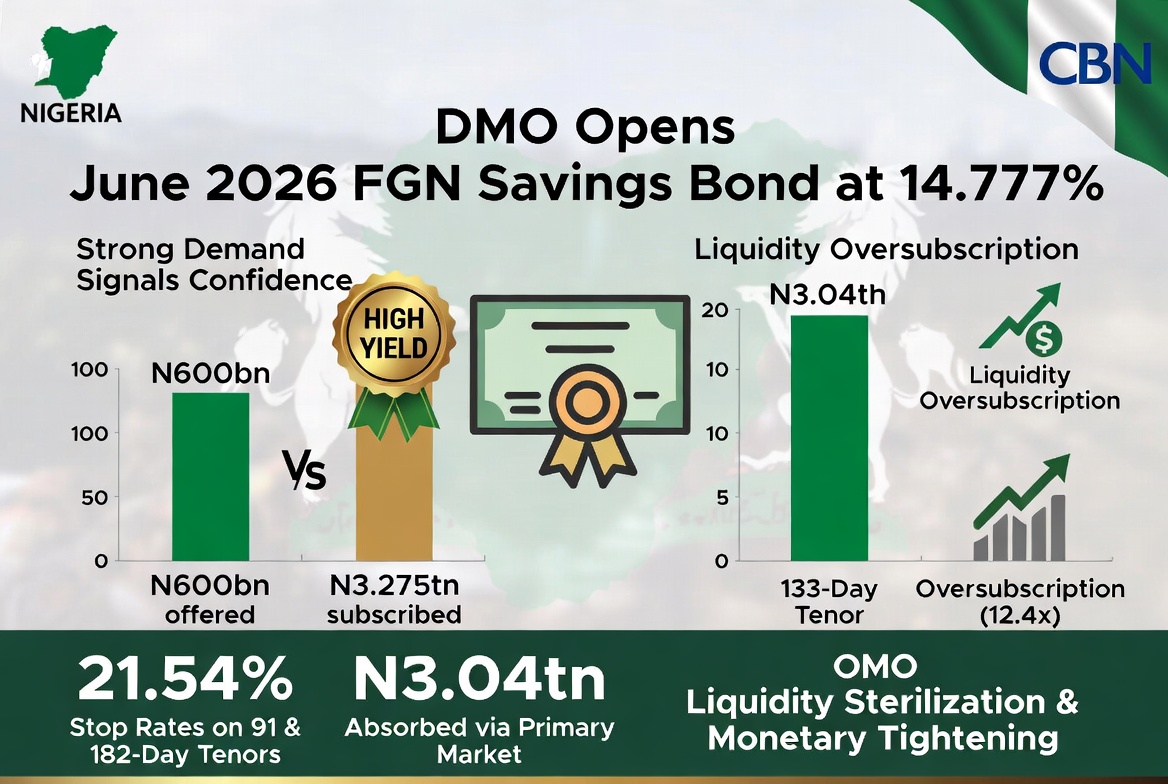
DMO opens June 2026 FGN Savings Bond offer at 14.777% interest
DMO opens June 2026 FGN Savings Bond offer at 14.777% interest The Central Bank of Nigeria (CBN) absorbed N3.04 trillion from the banking system through a single Open Market Operations (OMO) auction conducted on June 5, 2026, as investor demand across three tenors significantly exceeded the N600 billion offered by the apex bank. The development underscores the CBN’s continued aggressive liquidity sterilisation strategy, even as excess liquidity in the banking system showed some signs of easing during the review period. The latest auction follows two major OMO sessions in May that collectively absorbed trillions of naira from the financial system. What the data is saying: A breakdown of the June 5 OMO auction results shows exceptionally strong investor appetite, particularly for longer-dated instruments. The 7-day OMO bill recorded subscriptions of N179 billion against a N200 billion offer, with N169 billion allotted at a stop rate of 21.54%. The 35-day OMO bill attracted N614.43 billion in subscriptions compared to the N200 billion offered, while the CBN allotted N465 billion at a stop rate of 21.40%. The 133-day OMO bill emerged as the most sought-after instrument, drawing N2.48 trillion in subscriptions against a N200 billion offer and securing an allotment of N2.41 trillion at a stop rate of 20.02%. In aggregate, the CBN offered N600 billion, received subscriptions totaling N3.275 trillion, and successfully allotted N3.04 trillion, resulting in a net liquidity withdrawal of the same amount. The figures indicate that investors continue to channel excess liquidity into CBN sterilisation instruments, with a strong preference for longer-tenor securities despite lower yields. The 133-day bill’s 12.4-times oversubscription ratio highlights growing investor willingness to lock in funds for extended periods amid expectations of sustained monetary tightening. More insights: Additional market activity during the week further reduced liquidity within the financial system. Primary market operations on June 4 resulted in a net liquidity withdrawal of N992.68 billion, following N1.46 trillion in NTB and FGN bond sales against repayments of N464.60 billion. Opening balances of banks and discount houses declined from N108.27 billion on June 2 to N45.14 billion on June 3 before settling at N43.92 billion on June 5. This represents a decline of approximately N64.35 billion, equivalent to a 59.43% reduction over the period. The Standing Deposit Facility (SDF) balance moved from N5.29 trillion on June 3 to N5.35 trillion on June 4 before easing to N4.74 trillion on June 5. The moderation in SDF balances suggests that liquidity conditions are beginning to tighten, although substantial excess funds remain within the banking system. The data also shows that the CBN continues to rely primarily on OMO auctions and primary market operations for liquidity management during the current monetary policy cycle. What you should know: Recent projections indicate that substantial liquidity inflows are expected to enter the banking system during June despite the CBN’s aggressive sterilisation efforts. Financial Markets Dealers Association (FMDA) projections estimate total inflows of approximately N10.90 trillion into the banking system during June 2026. Of this amount, about N7.77 trillion is expected to originate from maturing OMO bills. The N3.04 trillion absorbed in the June 5 auction represents approximately 27.9% of the projected monthly inflows and effectively sterilised the N2.73 trillion OMO repayment that matured on the same day. Cumulative OMO sales between January and April 2026 had already reached approximately N30.12 trillion, reflecting an unprecedented pace of liquidity management by the apex bank. The latest auction reinforces expectations that the CBN’s tightening stance will remain firmly in place throughout the second quarter. By accepting N2.41 trillion on the 133-day bill alone, the apex bank appears to be extending the maturity profile of its OMO portfolio while reducing the likelihood of large liquidity injections from near-term maturities. However, the N4.74 trillion SDF balance recorded on June 5 suggests that excess liquidity remains a defining feature of Nigeria’s banking system despite the scale of recent liquidity mop-ups.
Read MoreNigeria’s Central Bank Policy Changes Impact on Business Finance
The latest policy changes by the Central Bank of Nigeria are reshaping how individuals and businesses interact with money. From stricter BVN controls to revised banking charges and tighter remittance regulations, one thing is clear: Nigeria’s financial system is becoming more structured, more transparent, and less flexible. This means how you plan, access, and manage money now matters more than ever. In a changing financial landscape, the right funding and financial strategy can make all the difference. This is where we come in, helping you navigate a more structured financial system with the right funding and financial strategy. Learn more about our services via the link below: www.syncfinanceng.com
Read More
Efficiency, Welfare and the Political Economy of Petroleum Subsidy Removal in Nigeria
By Temitayo Gbenro A Comparative Assessment of the Jonathan (2012) and Tinubu (2023) Episodes through the Lenses of Kaldor-Hicks and Pareto Efficiency Abstract Nigeria’s recurring fuel subsidy reform attempts represent one of the most consequential and contested fiscal policy episodes in sub-Saharan Africa. This paper conducts a rigorous comparative welfare analysis of two landmark subsidy removal episodes — the partial removal under President Goodluck Jonathan in January 2012 and the complete removal announced by President Bola Ahmed Tinubu on May 29, 2023 — applying both Kaldor-Hicks efficiency and Pareto optimality as normative frameworks. Drawing on macroeconomic panel data, price-pass-through econometric modelling (VAR/VECM with Error Correction Models), and household welfare indices, we evaluate whether aggregate efficiency gains were sufficient to theoretically compensate losers (Kaldor-Hicks), and whether any population segment was made unambiguously better off without others being made worse off (Pareto). We further assess the degree to which associated social reinvestment programmes — the Subsidy Reinvestment and Empowerment Programme (SURE-P, 2012) and Tinubu’s multi-modal palliative package (2023) — operationalised the compensatory redistribution that Kaldor-Hicks efficiency demands. Our findings indicate that both episodes generated theoretical aggregate efficiency surpluses consistent with weak Kaldor-Hicks efficiency, yet neither achieved Pareto improvements. In both cases, the welfare of the bottom two income quintiles deteriorated significantly, and the compensatory mechanisms were incompletely implemented, preventing the translation of fiscal gains into genuine welfare gains for the poor. We conclude with policy recommendations emphasising conditionality-linked social protection, transparent fiscal earmarking, and institutional reform of NNPCL. Keywords: Fuel Subsidy, Kaldor-Hicks Efficiency, Pareto Optimality, Nigeria, SURE-P, Social Welfare, Fiscal Policy, Price Pass-Through, Poverty JEL Classification: D61, D63, E64, H22, I38, O55, Q43 March 2026 1. Introduction Nigeria occupies a paradoxical position in the global energy landscape: the continent’s largest crude oil producer and one of its most energy-impoverished nations. For over five decades, successive federal governments sought to reconcile this contradiction through petroleum product subsidies, maintaining artificially suppressed retail fuel prices as a visible manifestation of the ‘resource dividend’ owed to citizens. By 2022, the subsidy on Premium Motor Spirit (PMS) had ballooned to ₦4 trillion (approximately US$6.1 billion), consuming 23 percent of the national budget and crowding out spending on infrastructure, education, and healthcare. Two presidential administrations attempted to break this cycle: President Goodluck Jonathan, who partially removed the subsidy on January 1, 2012, and President Bola Ahmed Tinubu, who announced its complete abolition in his inaugural address on May 29, 2023. Both episodes generated immediate and severe welfare shocks, abrupt fuel price increases, inflationary spirals, and public unrest, while simultaneously creating fiscal space that, in theory, could fund superior welfare outcomes. Each administration coupled its subsidy reform with reinvestment frameworks designed to redirect savings into social and infrastructure programmes: the Subsidy Reinvestment and Empowerment Programme (SURE-P) in 2012, and a multi-modal palliative package in 2023 including cash transfers, Compressed Natural Gas (CNG) infrastructure, and an economic stimulus fund. The central question this paper addresses is: did either episode satisfy the conditions of allocative efficiency required by welfare economics? We apply two complementary criteria. The Pareto criterion asks whether any reform configuration exists that could make at least one person better off without making anyone worse off. The Kaldor-Hicks (KH) criterion, a more practically relevant standard for policy evaluation, asks whether the aggregate gains to winners are sufficient to hypothetically compensate all losers, even if no such compensation is actually paid. Where compensation programmes were deployed, we additionally assess whether they effectively operationalised the KH principle in practice, converting theoretical efficiency into actual welfare improvement. This paper proceeds as follows: Section 2 provides historical context and a political economy overview. Section 3 develops the theoretical framework grounded in welfare economics. Section 4 presents the econometric model and methodology. Section 5 analyses macroeconomic and welfare data for both episodes. Section 6 evaluates SURE-P and the 2023 palliative package against welfare criteria. Section 7 discusses comparative findings. Section 8 offers policy recommendations, and Section 9 concludes. 2. Historical and Political Economy Context 2.1 The Subsidy Regime: Origins and Growth Nigeria’s fuel subsidy originated in 1973 as a temporary fiscal response to the global oil price shock, designed to insulate domestic consumers from international price volatility. What began as a pragmatic stabilisation tool evolved, through decades of institutional inertia and political economy entrapment, into a quasi-constitutional entitlement. Over 30 years and multiple administrations; Babangida (1986), Obasanjo (1999–2007), Yar’Adua, successive governments attempted and largely abandoned subsidy reform in the face of organised labour resistance and public opposition. The subsidy programme is characterised by a fundamental distributional paradox: its stated objective was to protect the poor, yet its actual incidence was regressive. Studies by the World Bank and IMF consistently found that the wealthiest quintile of Nigerian households, who consumed more fuel through private vehicles, generators, and commercial operations , captured a disproportionate share of subsidy benefits. Meanwhile, the poor, who disproportionately relied on firewood, kerosene, and public transport rather than PMS, received a smaller absolute benefit while bearing the full brunt of inflation and fiscal crowding-out effects. Compounding the distributional dysfunction was large-scale fraud. By 2012, a National Assembly investigation revealed that the annual subsidy bill had grown to ₦1.3 trillion from ₦240 billion in 2006, a 440 percent increase, partly attributable to phantom oil importers, fraudulent consignments, and systematic over-reporting. By 2022, NNPCL’s own Managing Director acknowledged that at least 58 million litres per day of PMS were being smuggled to neighbouring countries where retail prices were significantly higher, meaning Nigeria was effectively subsidising fuel consumption across the Gulf of Guinea. 2.2 The Jonathan Episode (2012) On January 1, 2012, Finance Minister Ngozi Okonjo-Iweala championed the abrupt removal of PMS subsidy, raising the pump price from ₦65 to ₦141 per litre, a 117 percent increase. The decision was made without prior public consultation and came into effect on a public holiday. The government’s stated rationale included: (i) redirecting ₦1.3 trillion in annual subsidy spending to infrastructure and social programmes; (ii) curbing subsidy fraud; (iii) stimulating private investment in downstream refining; and
Read More