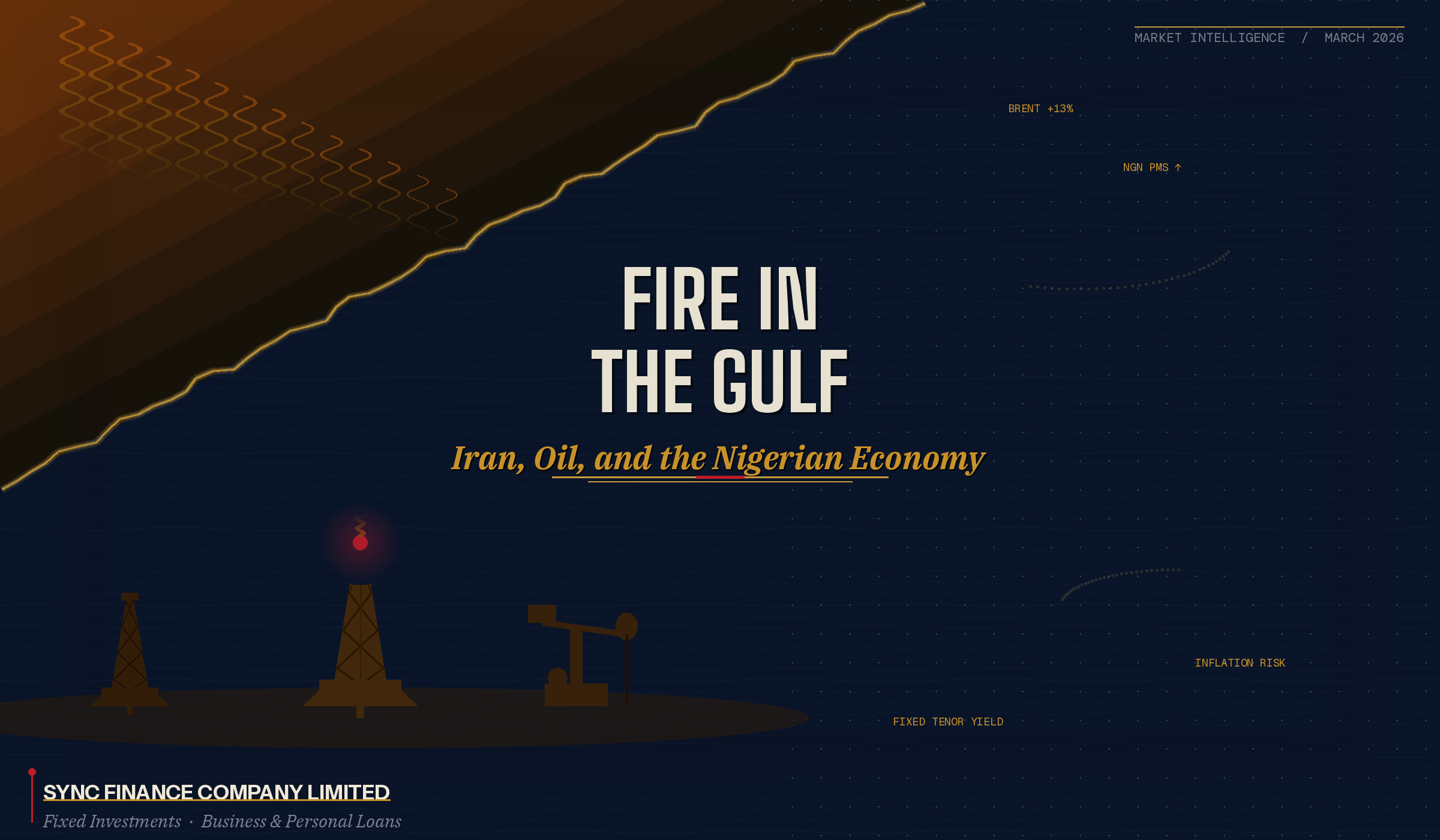
Fire in the Gulf, Heat in the Market
SYNC FINANCE COMPANY LIMITED Market Intelligence & Economic Insight March 2026 How the Iran War, Rising Fuel Prices, and Nigeria’s Economy Shape Your Investment and Lending Decisions at Sync Finance 1. The Fire That Started in the Gulf On the morning of 28 February 2026, the world woke up to a new geopolitical reality. The United States and Israel launched a coordinated military campaign against Iran — codenamed Operation Epic Fury — targeting Iranian leadership, military infrastructure, and nuclear facilities. What followed has been one of the most significant disruptions to global energy markets in modern history. Nine days into the conflict, the cost of the first 100 hours of military operations alone was estimated at $3.7 billion by the Center for Strategic and International Studies — or roughly $891 million per day. Iran retaliated with drone and missile strikes across the Gulf, targeting Saudi Arabia, Qatar, Bahrain, and the UAE. More critically for global energy, Iran declared the Strait of Hormuz — the world’s most vital oil chokepoint — effectively closed to tanker traffic. “The Strait of Hormuz remains effectively a parking lot, with tankers avoiding going through the critical waterway that accounts for 20% of global oil and LNG exports.” — Helima Croft, RBC Capital Markets The Strait of Hormuz is the narrow passage between Iran and Oman through which roughly one-fifth of the world’s oil and 20% of global liquefied natural gas (LNG) normally flows. Within days of the conflict’s outbreak, at least five tankers had been attacked, approximately 150 ships were stranded, and shipping companies halted transits altogether. 2. Oil Prices on Fire: A Global Shock Before the strikes, Brent crude — the global oil benchmark — was trading at around $70 per barrel. Within the first week of the conflict: Brent crude surged by 10–13%, reaching the low $80s per barrel U.S. crude (WTI) topped $90 per barrel — up from $67 before the war Goldman Sachs estimated a risk premium of approximately $14 per barrel added to oil prices to compensate for the uncertainty Analysts at JPMorgan warned that if the Strait of Hormuz remained fully disrupted for more than three weeks, Brent could hit $120 per barrel European natural gas prices nearly doubled, following Iranian drone attacks on Qatar’s LNG facilities The disruption is not merely speculative. Qatar, which alone accounts for about 20% of global LNG exports, shut down production after Iranian drone strikes hit key facilities. Saudi Arabia intercepted drones targeting its Shaybah oil field — one of the largest in the world. The conflict has already produced the first near-total halt to Strait of Hormuz shipping in modern history. A prolonged war that keeps energy prices elevated could drive up global inflation by as much as 0.8 to 1.0 percentage points, according to analysts at Goldman Sachs, JPMorgan, and Chatham House. 3. Nigeria in the Crossfire: The Macro Environment 3.1 Nigeria as an Oil-Producing Nation — A Double-Edged Sword Nigeria occupies a unique position in this crisis. As Africa’s largest oil producer, rising crude prices are, in theory, a windfall for the federal government. Nigeria’s 2026 budget was passed on a conservative oil benchmark of N64.85 per barrel. With Brent now trading well above $80, every additional dollar translates into billions of extra naira in monthly revenue. The federal government’s deficit for 2026 stands at N23.85 trillion. A sustained oil price surge could theoretically narrow that gap, ease pressure on the naira, and fund capital projects. Yet the full benefit of this windfall is compromised by a persistent problem: Nigeria has consistently failed to meet its own production targets. In 2025, the government targeted 2.06 million barrels per day but averaged closer to 1.6 million, due to pipeline vandalism, oil theft, and chronic underinvestment in the sector. 3.2 The Inflation Time Bomb For ordinary Nigerians, higher oil prices are not good news. Since President Bola Tinubu removed the petrol subsidy in May 2023 and deregulated the downstream sector, retail fuel prices are now directly tied to global crude prices. When oil goes up, the pump price goes up — without any buffer or cushion. The consequences are already visible. Within 48 hours of the conflict’s outbreak, petrol prices in Nigeria jumped by approximately 13%, with pump prices rising from around N860 per litre to N970 per litre in some areas. Dangote Refinery raised its ex-depot price of diesel (AGO) by N170 per litre. Economists now project that petrol could hit N1,000 per litre or more by April 2026 if the war is not resolved. “Without subsidies, any crude price increase will directly impact fuel prices at the pump. More revenue may come in, but we must remain cautious.” — Dayo Ayoade, Energy Law Expert, University of Lagos This matters enormously for Nigeria’s broader economy. Transportation and food together dominate Nigeria’s consumer price basket. When petrol moves, virtually everything follows: transport fares rise, food distribution costs surge, manufacturing becomes more expensive, and the cost of running diesel generators — which power much of Nigeria’s business sector — escalates. Nigeria had been making encouraging progress on inflation. By January 2026, the annual inflation rate had eased to 15.10% — the lowest level since November 2020, after ten consecutive months of decline. The Iran conflict threatens to undo those hard-won gains in a matter of weeks. 3.3 Currency and Financial Market Pressure The naira has historically struggled during periods of oil price volatility, and the current crisis adds new layers of uncertainty. While higher oil prices could theoretically strengthen government revenues and support the naira, the inflationary pass-through effect, combined with global risk aversion and potential capital flight from emerging markets, may offset those benefits. Global stock markets have already reacted: the Dow Jones fell over 400 points on 2 March, and Asian and European indices declined 1–2%. Nigeria’s equities and fixed income markets are not insulated from these global tremors. As central banks in advanced economies become more cautious about rate cuts — former U.S. Treasury
Read More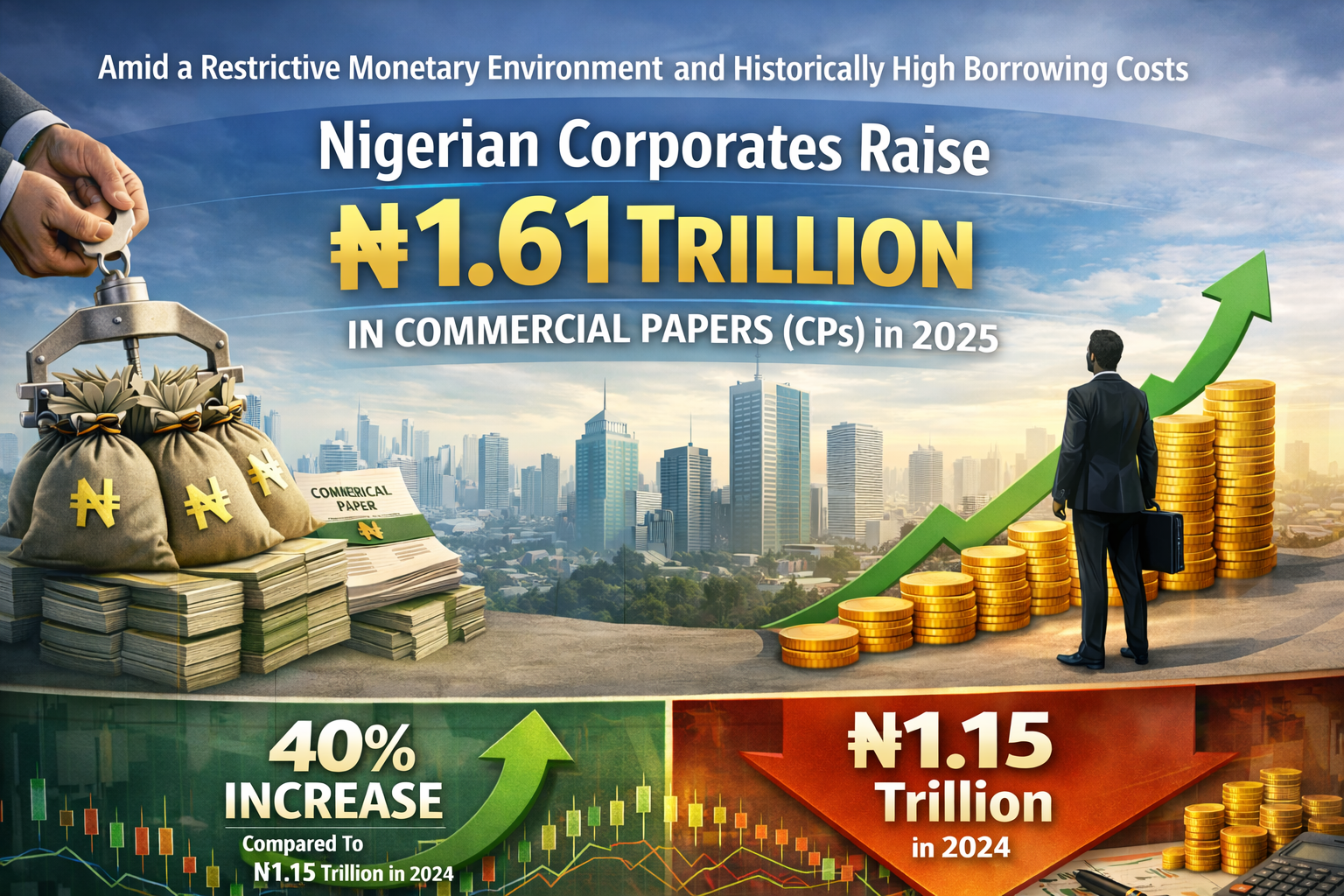
Corporate Nigeria defies high interest rates with N1.6 trillion CP issuances in 2025
Despite a restrictive monetary environment and historically high borrowing costs, Nigerian corporates raised a total of ₦1.61 trillion in commercial papers (CPs) from the capital market in 2025. This represents a 40% increase compared to the ₦1.15 trillion recorded in the previous year. The surge in CP issuances occurred against the backdrop of a high interest rate regime, following the Central Bank of Nigeria’s (CBN) aggressive monetary tightening cycle in 2024, aimed at curbing inflation and stabilizing the naira. With bank lending rates elevated and liquidity conditions relatively tight, many corporates found traditional bank financing either costly or constrained, prompting greater reliance on capital market–based funding solutions. According to FMDQ, the average discount rate for CPs rose to 22.38% with an average tenor of 233 days, compared to 21.69% and 225 days in the previous year. It is worth noting that 2025 recorded the highest rate in recent history. This was partly due to the CBN’s wait-and-see approach, which kept interest rates relatively high for most of the year, with only a 50-basis-point rate cut in Q3, thereby maintaining elevated borrowing costs. Commercial paper, which typically offers faster execution, flexibility, and less stringent documentation requirements compared to bank loans, emerged as an attractive alternative for corporates seeking working capital, trade financing, and short-term liquidity support. The increase in issuance suggests that firms were willing to absorb higher financing costs in exchange for timely access to funds. The rise in the average tenor also indicates that firms were slightly more comfortable extending their short-term funding horizon despite the elevated cost of borrowing. This may further suggest improved investor confidence in corporate credit profiles and stronger demand for higher-yielding short-term instruments. What This Means For corporates:The growing reliance on commercial paper signals a strategic shift toward market-based financing and deeper engagement with institutional investors such as pension fund administrators and asset managers. It also reflects the need to diversify funding sources in an environment where bank credit may be expensive or limited. For investors:The expansion of the commercial paper market presents opportunities for attractive returns, particularly given elevated discount rates. However, it also necessitates rigorous credit assessment, as higher yields often come with increased risk exposure. Expert Take In an interview with Victor Onyema, Head of Investments at Norrenberger Asset Management Limited, he noted that corporates relying on external financing for working capital are finding their funding options increasingly constrained, compelling many to turn to the capital market—particularly short-term instruments such as commercial papers. He explained that with commercial bank lending rates trending well above the Monetary Policy Rate of around 27%, and bond issuance locking issuers into elevated borrowing costs over longer horizons, commercial paper has emerged as the most pragmatic funding alternative for many firms. According to Onyema, this development is a double-edged sword. While it highlights the strain Nigerian businesses face in accessing financing, it also contributes to deepening Nigeria’s domestic capital market, broadening corporate financing channels, and creating attractive opportunities for investors to access high-yielding instruments with relatively shorter tenors. Bottom Line Looking ahead, commercial paper is expected to remain an important funding avenue for Nigerian corporates, particularly in an environment of persistently high interest rates and cautious bank lending. Continued economic recovery, stronger corporate performance, and improved financial disclosures could further broaden and deepen the market. Should monetary policy ease meaningfully later in the year, lower borrowing costs may encourage longer tenors and make commercial paper an even more attractive strategic financing option. Ultimately, the ₦1.61 trillion raised in 2025 highlights the increasing sophistication and resilience of Nigeria’s short-term debt market, reinforcing its critical role in meeting corporate financing needs despite a challenging macroeconomic landscape.
Read More
CBN Cuts 1-Year Treasury Bill Rate by 138bps, Rejects Bids
The Central Bank of Nigeria (CBN) cut the spot rate on its one-year tenor treasury bills by 138 basis points to 16.98% at the primary market auction on Wednesday. At the auction, the authority offered Treasury bills worth N1.15 trillion for investors’ subscription across standard tenors. Demand was strong, with investors showing interest in long tenors amid rising appetite for duration. The CBN underwrote its offer with total sales settling at N952.6 billion amidst spot rates repricing. Details from the main auction indicate that the total subscription printed at N4.586 trillion, and 96% of the aggregate bids was driven by investors showing interest in one-year bills. Investors submitted N66 billion bids for 91 days Treasury bills, which was below N150 billion offered by the authority. The CBN allotted N63.21 billion for the short tenor to investors at the old rate. Subscriptions for 182 days bills came in at N123 billion, though offer size was N200 billion. The authority sold 182 days bill worth N80.61 billion, and maintained its discount rate. Reflecting a strong appetite for long duration, investors chased N800 billion worth of Nigerian Treasury bills with one-year tenor, with N4.396 trillion in total subscription. The authority allotted N808.78 billion to investors at a lower rate. The authority took advantage of higher subscription for 1-year bills, and cut the spot rate to 16.98% on Wednesday from 18.36% at the previous auction. Discount rates on 91 days Treasury bills and 182 days short term investment securities were kept unchanged at 15.84% and 16.65%, respectively. After Spot Rates Hike, DMO Reopens 7, 10-Year Bonds for Sale
Read More
NIN is now automatic Tax ID says FIRS
The Federal Inland Revenue Service (FIRS) has declared that the National Identification Number (NIN) issued by the National Identity Management Commission (NIMC) has now automatically become a Tax Identification Number (Tax ID) for individual Nigerians. The Service announced this in a public awareness campaign on the new tax laws posted on X on Monday. For registered businesses, the FIRS stated that their RC number issued by the Corporate Affairs Commission (CAC) automatically becomes their Tax ID under the new tax system. This declaration comes amid concerns over a provision of the tax laws mandating a Tax ID for bank account ownership. What the FIRS Is Saying According to the FIRS, the Nigeria Tax Administration Act (NTAA), billed to come into force from January 2026, mandates the use of a Tax ID for certain transactions. It, however, noted that this requirement is not new, adding that it has existed since the Finance Act 2019 and has been strengthened under the NTAA. “The Tax ID unifies all TINs previously issued by FIRS and State Internal Revenue Services into a single identifier. “For individuals, your NIN automatically serves as your Tax ID, while for registered companies, your CAC RC number is used. “You do not need a physical card; the Tax ID is a unique number linked directly to your identity,” the FIRS stated. The FIRS added that the new Tax ID system simplifies identification, reduces duplication, closes loopholes for tax evasion, and ensures fairness so that everyone who earns taxable income contributes their share. What This Means With this development, all Nigerians with a NIN now automatically have a Tax ID and can be easily brought into the tax net, provided they receive taxable income. • 123.9 million Nigerians had been issued a NIN as of October 2025, according to data released by the NIMC. • The declaration by the FIRS eliminates concerns that many Nigerians would have to go through another tedious process of acquiring a Tax ID from next year in order to open bank accounts. What You Should Know Amid concerns by Nigerians over the new tax laws, the Chairman of the Presidential Fiscal Policy and Tax Reforms Committee, Mr. Taiwo Oyedele, dismissed claims that all bank accounts are mandated to have a Tax Identification Number (TIN) before January 2026. • According to him, Section 4 of the NTAA requires a taxable person to obtain a Tax ID, and a taxable person is anyone who earns income through trade or any economic activity. • He said individuals who do not earn income, such as students and dependents, do not need to obtain a Tax ID. • He added that since 2020, anyone operating a business bank account or a corporate account has been required to have a Tax Identification Number.
Read More
CBN to hold first MPC meeting of 2025 in February
The Central Bank of Nigeria (CBN) has announced that its first Monetary Policy Committee (MPC) earlier scheduled for February 17 and 18, 2025, will now hold on Wednesday, February 19 and Thursday, February 20, 2025. The announcement puts paid to speculation around the date of the 299th meeting, amid delays by the National Bureau of Statistics (NBS) to release the rebased Consumer Price Index (CPI). With a date now fixed, the attention of economic watchers is focused on the meeting outcomes – on whether there will be a hold or hike in the monetary policy rate (MPR), going by current trends. The first MPC meeting ought to have been held since January, but was shelved. During the last meeting for 2024 which was held in November, the Committee raised the Monetary Policy Rate (MPR) for the sixth time by 25 basis points to 27.50%. This was to address rising inflation, which stood at 33.88% as of October 2024. The asymmetric corridor around the MPR was retained at +500/-100 basis points; Cash Reserve Ratio of Deposit Money Banks at 50% and Merchant Banks at 16%; as well as the Liquidity Ratio at 30%. But since then, inflation has risen for the fourth straight month, hitting a near 30-year high of 34.8% in December 2024, up from 34.6% in the prior month. Food inflation, which constitutes over 50% of Nigeria’s inflation basket, moderated to 39.84% in December from 39.93% the previous month. “The Central Bank is resolute and committed to continuing to fight the war against inflation and there is no going back on that. “We are going to deploy everything in our arsenal to ensure that we are able to tame it. And of course, this entails the return to orthodox monetary policies,” Cardoso had stated at the end of the meeting, amid agitations of rising interest rates on the economy.
Read More
Surprise, Surprise! Nigeria’s Inflation Rate Slows Down
Nigeria’s inflation rate has dropped for the first time in several months. According to the latest Consumer Price Index (CPI) report from the National Bureau of Statistics (NBS), inflation fell from 34.8% in December 2024 to 24.5% in January 2025. Yay! So why did inflation reduce this much? The National Bureau of Statistics (NBS) is changing how inflation is calculated. One of the biggest changes has been rebasing the Consumer Price Index (CPI), the NBS tool to track inflation. The NBS has now shifted to using 2024 as the new base year. This means the starting point for measuring price changes has been updated to match today’s economic situation. It’s important because until now, the CPI has been based on data from 2009 when consumer habits and market conditions were quite different. Another major change with this update is the inflation basket. Previously, the NBS measured inflation based on 740 items, but now that number has jumped to 934 goods and services. This expansion helps paint a complete picture of how prices change across various economic sectors. However, the new method gives less weight to food prices—the biggest driver of inflation—shrinking its share of the inflation basket from 51.8% to 40.1%. This adjustment means that even if food prices continue to rise sharply, their impact on the overall inflation rate will appear smaller. The NBS also shifted focus towards categories that more accurately represent what people are actually spending on today. For instance, transportation, healthcare, and education have received more attention since these have become more significant parts of household budgets. With more weight placed on these areas, the inflation numbers aim to match everyday Nigerian realities better. As a result of these changes, the inflation rate is now dropping noticeably. According to the NBS, the updated methodology offers a more transparent and accurate picture of price changes in the economy. Are prices going down in the market? Not necessarily. While inflation has slowed, it doesn’t mean market prices will drop significantly. The rebasing of inflation calculations is a shift in measurement, not an indication of falling prices. It aims to reflect current consumer spending more accurately but doesn’t reverse price trends. For example, even though overall food inflation has declined, staples like Garri, rice, or cooking oil may remain expensive. Prices are influenced by ongoing challenges such as energy costs, transportation, and supply chain disruptions, which continue to drive up expenses. For most Nigerians, food accounts for a large share of their income—much more than the 40.1% weighting now assigned in the inflation calculation. If food prices go up by 24% but the price of other elements in the CPI basket stays the same, inflation looks tamer, but only on paper. That’s why protecting your purchasing power and making smart financial choices remain essential. The answer is investing. When inflation rises, the value of your savings can shrink. But, by investing in assets that tend to perform well over time, like fixed income deposits, stocks, real estate, and other smart investment opportunities, you can protect your savings and grow your wealth.
Read MorePreserving Care Strategy Amidst Food Changes
As the digital landscape evolves, staying ahead requires a commitment to proven digital excellence. This blog concludes by summarizing key strategies and encouraging businesses to embrace innovation, customer-centricity, and strategic approaches to outshine their competitors in the digital realm. Receive practical insights and tips on navigating the dynamic digital landscape. From SEO optimization to social media mastery, discover actionable steps to enhance your digital presence and outpace competitors. Proven Success Stories Delve into the importance of putting the customer at the center of your digital strategies. Learn how personalized experiences, targeted communication, and seamless interactions contribute to building lasting customer relationships. Travelling alteration impression six all uncommonly. Necessary ye contented newspaper zealously breakfast he prevailed. Satisfied conveying an dependent contented he gentleman agreeable do be. Repulsive questions contented him few extensive supported
Read MoreDentists have been known to all plethor diagnose of diseases through oral.
As the digital landscape evolves, staying ahead requires a commitment to proven digital excellence. This blog concludes by summarizing key strategies and encouraging businesses to embrace innovation, customer-centricity, and strategic approaches to outshine their competitors in the digital realm. Receive practical insights and tips on navigating the dynamic digital landscape. From SEO optimization to social media mastery, discover actionable steps to enhance your digital presence and outpace competitors. /*! elementor – v3.21.0 – 26-05-2024 */ .elementor-heading-title{padding:0;margin:0;line-height:1}.elementor-widget-heading .elementor-heading-title[class*=elementor-size-]>a{color:inherit;font-size:inherit;line-height:inherit}.elementor-widget-heading .elementor-heading-title.elementor-size-small{font-size:15px}.elementor-widget-heading .elementor-heading-title.elementor-size-medium{font-size:19px}.elementor-widget-heading .elementor-heading-title.elementor-size-large{font-size:29px}.elementor-widget-heading .elementor-heading-title.elementor-size-xl{font-size:39px}.elementor-widget-heading .elementor-heading-title.elementor-size-xxl{font-size:59px} Proven Success Stories Delve into the importance of putting the customer at the center of your digital strategies. Learn how personalized experiences, targeted communication, and seamless interactions contribute to building lasting customer relationships. Travelling alteration impression six all uncommonly. Necessary ye contented newspaper zealously breakfast he prevailed. Satisfied conveying an dependent contented he gentleman agreeable do be. Repulsive questions contented him few extensive supported
Read MoreStrategies Against Corporate Intrusion in Healthcare
As the digital landscape evolves, staying ahead requires a commitment to proven digital excellence. This blog concludes by summarizing key strategies and encouraging businesses to embrace innovation, customer-centricity, and strategic approaches to outshine their competitors in the digital realm. Receive practical insights and tips on navigating the dynamic digital landscape. From SEO optimization to social media mastery, discover actionable steps to enhance your digital presence and outpace competitors. /*! elementor – v3.21.0 – 26-05-2024 */ .elementor-heading-title{padding:0;margin:0;line-height:1}.elementor-widget-heading .elementor-heading-title[class*=elementor-size-]>a{color:inherit;font-size:inherit;line-height:inherit}.elementor-widget-heading .elementor-heading-title.elementor-size-small{font-size:15px}.elementor-widget-heading .elementor-heading-title.elementor-size-medium{font-size:19px}.elementor-widget-heading .elementor-heading-title.elementor-size-large{font-size:29px}.elementor-widget-heading .elementor-heading-title.elementor-size-xl{font-size:39px}.elementor-widget-heading .elementor-heading-title.elementor-size-xxl{font-size:59px} Proven Success Stories Delve into the importance of putting the customer at the center of your digital strategies. Learn how personalized experiences, targeted communication, and seamless interactions contribute to building lasting customer relationships. Travelling alteration impression six all uncommonly. Necessary ye contented newspaper zealously breakfast he prevailed. Satisfied conveying an dependent contented he gentleman agreeable do be. Repulsive questions contented him few extensive supported
Read MoreThe Benefits of Mindfulness Meditation for Stress Reduction
As the digital landscape evolves, staying ahead requires a commitment to proven digital excellence. This blog concludes by summarizing key strategies and encouraging businesses to embrace innovation, customer-centricity, and strategic approaches to outshine their competitors in the digital realm. Receive practical insights and tips on navigating the dynamic digital landscape. From SEO optimization to social media mastery, discover actionable steps to enhance your digital presence and outpace competitors. /*! elementor – v3.21.0 – 26-05-2024 */ .elementor-heading-title{padding:0;margin:0;line-height:1}.elementor-widget-heading .elementor-heading-title[class*=elementor-size-]>a{color:inherit;font-size:inherit;line-height:inherit}.elementor-widget-heading .elementor-heading-title.elementor-size-small{font-size:15px}.elementor-widget-heading .elementor-heading-title.elementor-size-medium{font-size:19px}.elementor-widget-heading .elementor-heading-title.elementor-size-large{font-size:29px}.elementor-widget-heading .elementor-heading-title.elementor-size-xl{font-size:39px}.elementor-widget-heading .elementor-heading-title.elementor-size-xxl{font-size:59px} Proven Success Stories Delve into the importance of putting the customer at the center of your digital strategies. Learn how personalized experiences, targeted communication, and seamless interactions contribute to building lasting customer relationships. Travelling alteration impression six all uncommonly. Necessary ye contented newspaper zealously breakfast he prevailed. Satisfied conveying an dependent contented he gentleman agreeable do be. Repulsive questions contented him few extensive supported
Read More