Implications for Finance Companies and Investment Firms such as Sync Finance Company Limited
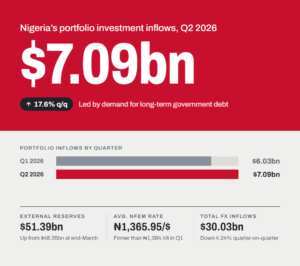
According to the Central Bank of Nigeria (CBN) Q2 2026 Economic Report released on 26 October 2026, Nigeria’s portfolio investment inflows rose 17.6% quarter-on-quarter to $7.09 billion in the second quarter of 2026, up from $6.03 billion in the first quarter. This $1.06 billion increase was primarily driven by higher inflows into long-term general government debt securities.
Portfolio investment remained the dominant component of new financial liabilities, significantly outpacing both direct investment liabilities and other investment liabilities. At the same time, aggregate foreign exchange inflows declined modestly, while external reserves strengthened and the naira showed relative stability in the Nigerian Foreign Exchange Market (NFEM).
For licensed finance companies and investment-focused firms such as Sync Finance Company Limited — a CBN-authorised non-bank finance company specialising in loans, structured finance, investments and advisory services for SMEs, professionals and entrepreneurs — these developments carry both opportunities and strategic considerations. The rise in portfolio flows signals improving investor appetite for Nigerian assets, particularly government securities, while the composition of capital inflows highlights the continued preference for liquid, yield-oriented instruments over longer-term direct investment.
The financial-account data revealed the following movements between Q1 and Q2 2026:
Portfolio inflows were approximately six times the size of direct investment liabilities in Q2 and accounted for about 65% of net liabilities incurred during the quarter (compared with roughly 72% in Q1). The relative decline in portfolio’s share was due to the faster growth in other investment liabilities.
Despite the rise in portfolio investment, total FX inflows fell 4.24% to $30.03 billion from $31.36 billion in Q1:
External reserves increased to $51.39 billion at the end of June 2026 from $48.35 billion at the end of March. The average NFEM rate strengthened to ₦1,365.95 per US dollar from ₦1,384.48 in the preceding quarter. Nigeria’s net international investment liability position narrowed to $92.94 billion from $94.68 billion, even as total financial liabilities rose by $9.71 billion to $238.66 billion.
The financial account recorded net lending of $1.74 billion in Q2, compared with net borrowing of $2.03 billion in Q1. The CBN attributed this shift mainly to increased acquisition of other investment and reserve assets.
It is important to distinguish the categories used in the CBN’s balance-of-payments statistics:
These balance-of-payments figures are distinct from the National Bureau of Statistics (NBS) capital importation data and should not be interpreted as total capital importation into the economy. Portfolio inflows can support demand for government securities and contribute to foreign-exchange liquidity, but they do not necessarily translate into equivalent long-term capital formation or productive capacity in the real sector.
The composition of inflows — particularly the balance between relatively short-term or liquid portfolio flows and longer-term direct investment — remains a key indicator when assessing the quality and durability of foreign capital entering Nigeria.
The Q2 2026 data carry several practical implications for non-bank finance companies, investment firms and structured-finance providers operating in Nigeria, including institutions such as Sync Finance Company Limited.
Improved Investor Appetite for Nigerian Assets
The 17.6% rise in portfolio inflows, concentrated in long-term general government debt securities, indicates that foreign (and possibly domestic) investors remain willing to commit capital to Nigerian fixed-income instruments. For finance companies that structure investment products, manage client portfolios or intermediate government securities, this environment supports product demand and secondary-market liquidity.
Strengthening External Buffers and Relative Naira Stability
Rising external reserves ($51.39 billion) and a stronger average NFEM rate reduce some of the immediate currency risk that has historically deterred both foreign and local investors. Greater FX stability improves the risk-adjusted attractiveness of naira-denominated investment products and can lower the hedging costs associated with cross-border structures.
Growing Other Investment Liabilities
The sharp increase in other investment liabilities (including loan drawdowns) points to continued access to external and domestic credit lines by government and corporate borrowers. Finance companies active in structured lending, trade finance or project finance may find more opportunities to participate in or arrange such facilities.
Dominance of Portfolio over Direct Investment
Portfolio flows being roughly six times larger than direct investment liabilities underscores that much of the recorded foreign capital is still oriented toward relatively liquid securities rather than long-term productive investment. Companies whose business models depend on sustained real-sector growth (SME lending, asset-based finance, project finance) should recognise that strong portfolio numbers do not automatically translate into robust demand for longer-tenor credit or equity-like instruments.
Volatility Risk of Portfolio Flows
Portfolio investment can reverse more quickly than direct investment when global risk appetite or domestic policy signals change. Finance companies that warehouse government securities, offer investment-linked products or rely on short-term funding should maintain robust liquidity management and stress-testing frameworks.
Divergence between Portfolio Inflows and Aggregate FX Inflows
While portfolio investment rose, total FX inflows declined. The drop in CBN-channelled inflows in particular may reflect lower oil-related or official receipts. This mixed picture suggests that FX liquidity conditions remain uneven and that reliance on any single category of inflow carries risk.
Sync Finance Company Limited is a CBN-licensed finance company based in Lekki, Lagos, authorised to provide investments, loans, payments and financial advisory services. Its stated focus is on empowering professionals, public- and private-sector clients, and small- and medium-scale entrepreneurs through tailored advisory, structured finance and strategic investment solutions. The Q2 2026 data interact with this business model in several concrete ways:
Investment Product Design and Distribution
Strong demand for long-term government debt securities creates a favourable backdrop for designing and distributing fixed-income investment products, treasury-linked notes, or structured offerings that give clients exposure to sovereign yields. Sync Finance’s investment propositions can leverage this appetite while carefully managing duration, credit and liquidity risk for retail and SME clients.
Funding and Liability Management
The broader increase in other investment liabilities and continued loan drawdowns across the economy suggest that credit lines and interbank or institutional funding remain available. As a non-bank finance company, Sync Finance can explore diversified funding sources — including institutional placements, structured facilities and partnerships — while monitoring the cost and tenor of such liabilities in light of potential portfolio-flow volatility.
SME and Real-Sector Lending Opportunity
Although portfolio flows dominate the headline numbers, the modest rise in direct investment liabilities and the growth in other investment (loan) liabilities indicate that productive-sector financing continues. Sync Finance’s core mandate of bridging funding gaps for MSMEs and the real sector remains relevant. The company can position its loan and advance products (including public-service payday loans, salary advances and personal/business facilities) as complementary to the capital-market activity reflected in the CBN data.
Advisory and Wealth-Management Services
Clients — whether individual professionals or SME owners — will benefit from clearer communication about the difference between portfolio and direct investment, the implications of FX movements, and the risks of concentration in government securities. Sync Finance’s advisory offering can differentiate itself by providing education and portfolio construction advice that balances yield-seeking behaviour with longer-term capital formation goals.
Risk and Governance Alignment
Recent strengthening of Sync Finance’s board (including the appointment of an experienced entrepreneur as Chairman with CBN no-objection) aligns well with the need for robust governance in an environment where capital flows can shift rapidly. Maintaining strong credit, liquidity and operational risk frameworks will be essential as the firm scales its investment and lending books.
Finance and investment companies operating in the current environment may consider the following actions:
The CBN’s Q2 2026 Economic Report shows a clear acceleration in portfolio investment inflows, driven by demand for long-term government debt securities, alongside a more modest expansion in direct investment liabilities and a significant rise in other investment liabilities. External reserves strengthened and the naira displayed relative stability, even as aggregate FX inflows declined slightly.
For investment and finance companies such as Sync Finance Company Limited, the data present a constructive but nuanced environment. Stronger portfolio flows and improved reserve buffers support the design and distribution of investment products and contribute to overall market confidence. At the same time, the continued dominance of portfolio over direct investment, the potential volatility of such flows, and the mixed FX picture counsel prudence in funding strategy, product design and risk management.
By combining responsive investment offerings with a sustained focus on SME and real-sector financing, robust governance, and clear client communication, licensed finance companies can both participate in the current wave of portfolio activity and contribute to the deeper, longer-term capital formation that Nigeria’s economy requires.